Tuesday, June 23, 2009

Next Generation LED Flashlights: TerraLUX Lightstar 220

Since I've been riding around on my electric scooter and driving a pedicab downtown at night, I've taken an interest in bicycle lights and flashlights. Getting a small, light weight, bicycle light that is bright enough to been seen at night was relatively easy. But getting a light bright enough to see out night was always tough. The bicycle lights have been heavy (battery the size of a water bottle), expensive, and/or had short run times.

But I have discovered that the new generation of LED flashlights are far superior to the old flashlights we are use to. They are small, lightweight, relatively inexpensive (less than $50), and throw off a beam that is orders of a magnitude brighter than your typical household flashlight or even something like a Mag flashlight, which I thought were never that impressive to begin with. Most of the new LED flashlights are built around a CREE lamp. Most of them are regulated which means the maintain consistence brightness with varying battery voltages. They are sold under brand names you probably never heard of like Fenix, TerraLUX, ITP, EagleTac, and others. They are built with anodized aluminum instead of the cheap plastics that most flashlights and bicycle lights (i.e. Cateye) are made out of.

They are powered either by lithium cells or the more common AA/AAA batteries. The ones powered by lithium seem to offer better performance. Either they are smaller or lighter or they are bright and/or last longer in a given size. However, AA/AAA cells are much easier to find (in virtually every store) when the batteries do die.

The flashlight I have here is a TerraLUX Lightstar 220. It has a claimed brightness of 220 lumens. It is the brightest flashlight I have ever owned. It is powered by just 2 AA batteries and will last about 2 hours at the high setting on a set of AA Energizer 2500 NiMH rechargeable batteries. It claims to have a 6 hour run time on the low setting. It's pretty easy to carry an extra set of AA batteries in your pocket or find a set if the run times aren't long enough.

It's bright enough for cycling at night with a flashlight handlebar mount and will easily light up 50 yards in front of you. If you want more light, it would not be hard to mount two of these on a bicycle handlebar because they are small enough. It seems to be sturdy built out of anodized aluminum. There are 2 settings high and low. The low setting seems to be about half as bright and is useful since the high setting may be too bright for close up work.

It comes with a wrist strap and pouch. I got a $2 flashlight handlebar mount from MeritLine.com that seems to work well enough. Assuming this flashlight proves to be durable enough, I recommend it as a cycling headlight (any taillight usually works fine) or as a general purpose flashlight. If you've never seen one of these, you'll be amazed to how small and bright they are. The lithium powered versions are probably smaller, lighter, brighter, and/or last longer, but I like using AA cells as I know I can get them anywhere.

Labels: , ,

Wednesday, January 21, 2009

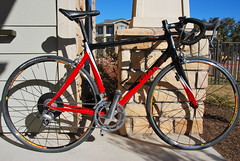
Giant 2008 TCR C2 Road Bike. First Ride.

After riding my 2002 Giant aluminum TCR for 6 years, it finally bit the dust. Back in 2002, I destroyed my brand new steel Bianchi after a couple months by crashing in a race. I had a 2001 and a 2002 Giant TCR aluminum frame. There wasn't any particular reason for me to get one. They were cheap ($600 frame/fork/headset), light, and rode surpassingly nice considering the price. I destroyed my 2001 several months ago by driving into a parking garage while it was still on the roof. I destroyed the bike and the roof rack.  I know, please tell me what an idiot I am. :( My 2002 Giant finally bit the dust when a car backed into in the parking garage of my condo.

The Giant TCR was surprisingly nice ride for a race bike, especially one made out of aluminum. The ride wasn't harsh like the old Cannondales. In fact, it was quite comparable to a stiff steel frame. The handling was much quicker than my 1999 Jamis Eclipse, but still quite stable. What stood out about it was the acceleration. It was noticeably better than anything I had ridden before.

I decided to go with another Giant since I had been riding this for so long and didn't want to mess with my setup. I was quite happy with my Giant TCR and getting a new bike set up has always been a hassle, so I decided to just get the same frame to make transitioning to the new bike as easy as possible.

My old bike was a medium, which was a bit too small. But back then, there was only small, medium, and large. Now they have a medium large, which seems perfect for my 6 ft. frame.

This bike is a 2008 TCR C2. I got it at University Cycles for $2000. It was 10% of the list price as they are getting closing out their 2008 line. The 2009 version is much more expensive as the bike industry have raised prices across the board for this year. It features Giant's monocoque one piece full carbon frame, a full Ultegra drivetrain, and Mavic Aksium wheelset. The bike is not particularly light. After adding my Speedplay Zero stainless pedals, water bottle cages, and Cateye wireless computer, and my saddle (a Bel Air SDG that I've been using for the last 10 years) the total weight comes to around 19.5 lbs

I finished my first 20 mile ride today and my first impression is, WOW! It rides and handles very much like my old aluminum TCR, but much smoother and well behaved way. That's the first thing I notice about it. There's much less road feel since it absorbs the bumps in the road so well. I thought the TCR aluminum frame was fairly plush, but this frame is so much smoother. In fact, it's so smooth that it feels like I'm going slower, but one look at the cyclometer shows that I'm going a bit faster if anything. I easily got it up over 30 mph many times, and I'm not in particularly great shape.

Handling is very quick, but a tad more relaxed than my old bike. After all, this is a size larger than my old bike, which results in a longer wheelbase, longer top tube, and slightly more relaxed seat angle. I did a handful of sprints and I can say out of the saddle acceleration is noticeably quicker than my old TCR bike. The ride and handling of any road bike is determined mainly by the wheels and the frame. The improvements on the wheelset and frame are quite noticeable after 6 years. The handles quickly without being twitchy. I got it up to 35 mph riding back into town on 2244 and it was very stable.

The drivetrain is standard Shimano Ultegra. I'm glad to finally be back riding Shimano. This is the first time that I have ridden Shimano 10 speed drivetrain. I have been riding Campy for the past 8 years and the quirks to get annoying. The good thing about Campy is that things can usually be fixed or rebuilt if they break. The bad is that it usually is pretty expensive for parts. Meanwhile, Shimano stuff generally needs to be replaced when it breaks. The shifting on the Shimano is very smooth and the action is very light. The shifting action on Campy does require more force on the levers and the action is much louder. Both work well if adjusted well, but my feeling is that it's much easier to use the Shimano drivetrain. It's also easier to find parts and accessories to work with Shimano. Overall, it's an improvement over my 2003 Campy Chorus drivetrain. The downside is that none of my rear wheels will work with this bike!

Those are my first impressions. I'll write more about this bike as I spend more time with it, but if you have any questions, just email me.

Labels: , , ,